

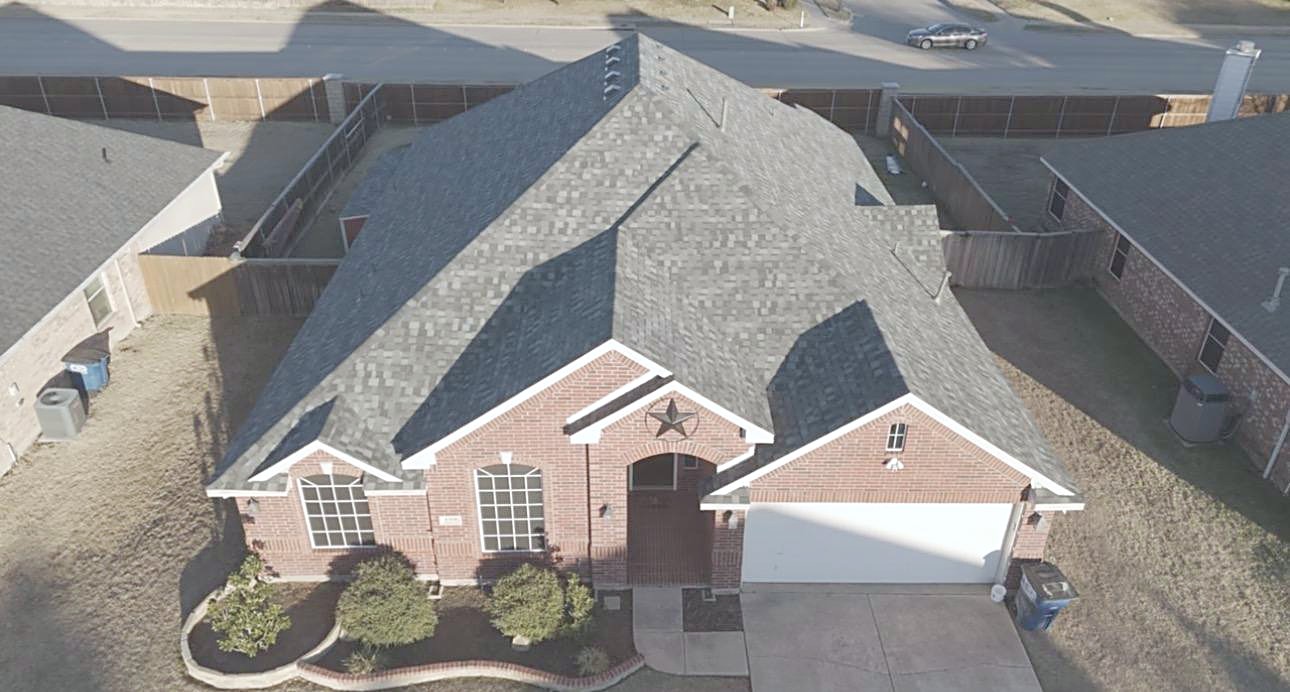
How can I tell if my roof has hail damage?
Start with what you can see from the ground: dents in gutters, downspouts, roof vents and the AC unit, torn window screens, spatter marks on fences, and shingle granules collecting at the bottom of downspouts. Those mean hail large enough to damage shingles hit the house. The shingles themselves have to be checked up close, which is what a roof inspection is for.
Soft metal tells you what the shingles took
Aluminum gutters, downspouts and roof vents dent easily and keep the dent, so they are a record of the storm. Round dents on the side of the downspouts facing the storm, and on the tops of gutters and vent caps, tell you both the size of the hail and the direction it came from.
The fins on the outdoor AC unit are softer still. A unit that took a lot of hail looks as if someone pressed a comb into it.
Granules in the downspouts are the shingles wearing away
Asphalt shingles are covered in ceramic granules that protect the asphalt from the sun. Hail knocks them loose. After a storm, a pile of dark sand at the outlet of a downspout, or a gritty layer in the gutters, is those granules.
Some granule loss is normal on a new roof and on an old one. A sudden pile after a hailstorm is not.
What hail does to a shingle up close
On the roof, a hail hit on a shingle shows up as a dark spot where granules are missing, often with a soft, bruised feel when pressed, because the fiberglass mat underneath has fractured. Harder hail on older shingles can crack them outright or break off corners.
The pattern matters as much as the hits. Storm damage is random and concentrated on the slopes facing the storm. Blistering, cracking in straight lines and wear that follows the path of water are age, not hail.
Do not climb up to check
A pitched roof after rain is slippery, and hail damage is easy to miss and easy to make worse by walking on bruised shingles. The ground checks above are enough to decide whether an inspection is worth booking, and the inspection is free.
Related questions
Can hail damage a roof without causing a leak?
Yes, and it usually does. Bruised shingles keep shedding water at first and fail over the following seasons as the exposed asphalt dries out.
Does hail damage show up on satellite images?
Not reliably. Bruising on individual shingles is far too small for aerial imagery, which is why roofs are inspected in person.